
Autumn Moon Festival
Bridging Cultures through Educational Experiences

Role:
Project Manager/Designer
Project Type:
Website
Tools:
Figma, Google Suite, Trello, ChatGPT, Dovetail
Our team was tasked with creating an educational website to promote a multicultural Autumn Moon Festival(AMF) event, hosted by the San Diego Vietnamese American Youth Alliance.
Using the festival event as a broader context, we designed with the following objectives in mind:
Create an educational and visually appealing site that uplifts the Autumn Moon traditions of other cultures
Bring awareness to the history, traditions, and practices of other cultural festivals with sincerity, sensitivity, and respect
As a Project Manager(PM), I coordinated and led meetings with our team and mentor, as well as created meeting agendas and project timelines. I also tracked team and individual deliverable deadlines, balancing accountability with thoughtful leadership. Beyond my PM responsibilities, I also assisted with background research, reaching out to nonprofits, creating the site information architecture, prototyping the high-fidelity wireframe, and conducting User Testing interviews.
Challenges → Solutions
Identifying Target Users, Behaviour, and Experiences
Facilitated a multi-method research approach using surveys, interviews, competitive analysis, and secondary analysis using deep AI
Encouraging Cultural Engagement with New Audiences
Designed an interactive and visually engaging map, encouraging users to learn about different cultures
Created a modern, unique site branding to attract new users
Organization of Educational and Logisitical Information
Created information architecture to map out website sections
Designed a compact yet informative navigation bar with clear page titles and overviews
Project Time Constraints
Created a flexible timeline, facilitated collaboration to keep team members engaged and productive
Managed team deliverable priorities through twice-weekly meetings
User Research
Insights
After collecting 129 survey responses, conducting 6 interviews, and conducting competitive and deep AI analysis, we arrived at the following insights. These insights guided our design decisions throughout the rest of the design process.
Culture & Representation
Multi-ethnic breadth: AMF isn’t one festival but many overlapping ones
Beyond borders: Represent multi-Asian and blended identities, not just separate traditions. Diasporic adaptations should be embraced as authentic.
Content & Information Architecture
Users preferred a visually forward design with scannable written content
Content priorities: Food & family as universal entry points. Legends & storytelling → cultural richness. History & behind-the-scenes → educational depth. Events & logistics → practical gateway to participation.

Survey Analysis Insights & HMW Statements

Interview Affinity Mapping

Competitive Analysis
Design Process
Information Architecture

Iteration 1 - Focused on laying out a foundation of pages

Iteration 2.1 - Exploration of educational pages, organized by subject
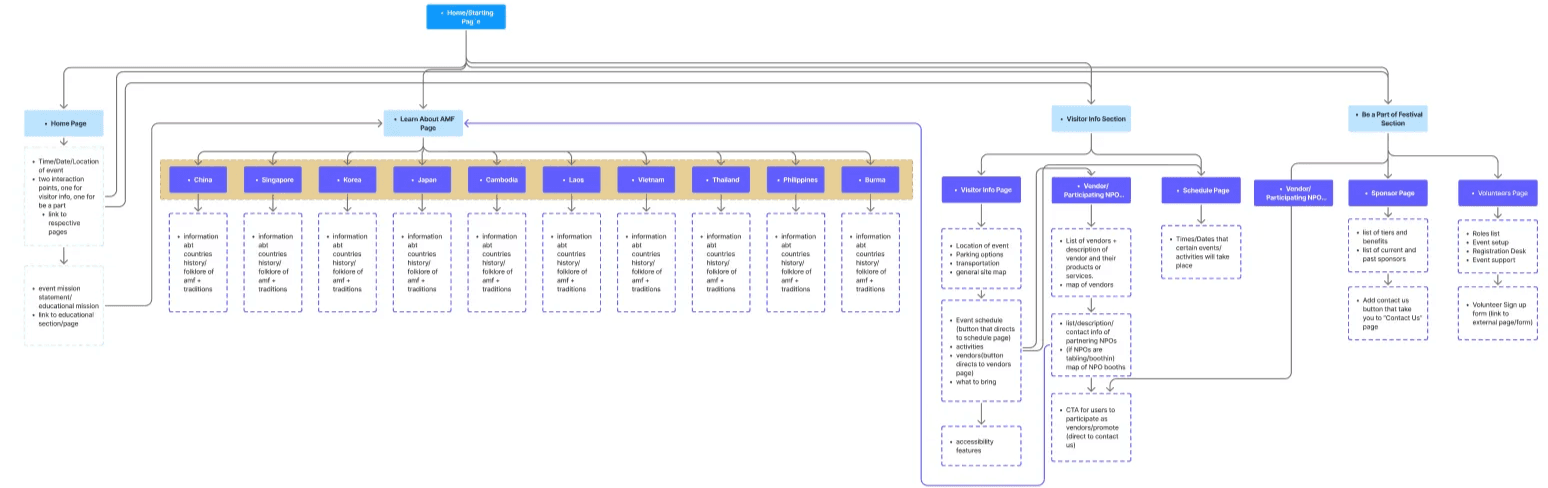
Iteration 2.2 - Exploration of educational pages organized by festival/country
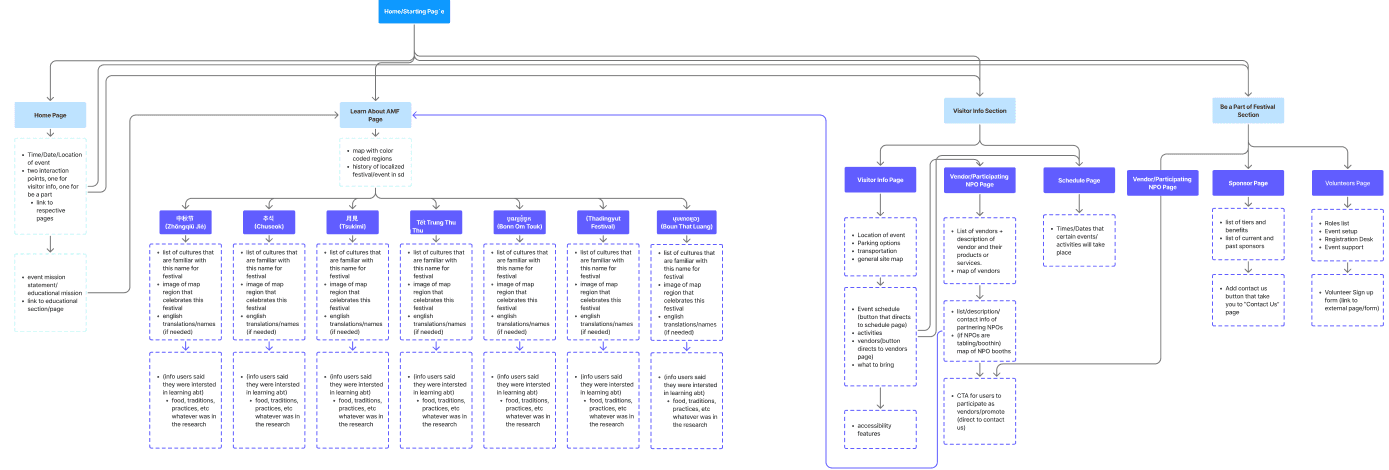
Iteration 3- Final Iteration, incldues a section landing page for educational section that would contain an interactive map and the History of the San Diego Autumn Moon Festival events
High Fidelity Prototype and Development

Page Layouts for educational section pages - Each page features images and visual assets that correspond to the representative cultural celebration

Interactive Map - encourages users to explore different region's Autumn Moon Festival through a more visually engaging and interactive format
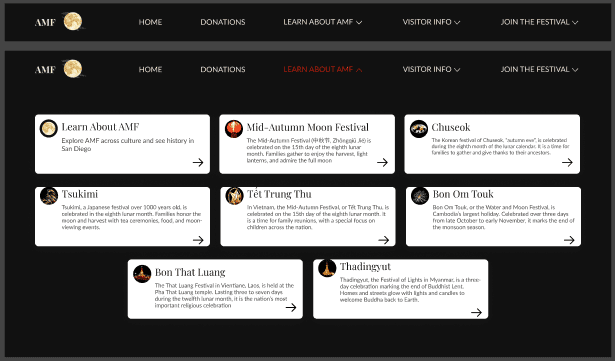
Nav Bar & Nav Bar Dropdowns for “Learn about AMF” Section - shares a basic overview of each celebration in a compact layout

Dropdowns for Visitor Info and Join the Festival sections. Due to time constraints, and being a secondary priority, icons were not added to these cards
We were also able to ship a live version of the website with a functional navigation bar, all site pages, and high-fidelity pages for the home page and educational section. However, due to time constraints, we were unable to implement the interactive map on the main "Learn about AMF" landing page, or complete the information for the Visitor Info and Join the Festival Sections.
User Testing / Design Validation
With high-fidelity prototypes in place, we conducted four task-based user testing sessions focusing on design validation to ensure our page designs met user needs and expectations, and gaining information that could yield quick yet substantive revisions for the site. Testing sessions were conducted on Zoom and recorded using an AI notetaker. Participants shared their screens as they did tasks, and were encouraged to give a verbal commentary of their actions and feelings as they went through the site.
Results & Revisions
After conducting 4 user testing sessions with users, we conclued that our product accomplished our primary goal. On average, familiarity scores increased by 1.125 points from the beginning to the end of the testing session, showing that our website was effective at bringing awareness to the history, traditions, and practices of other cultural festivals with sincerity, sensitivity, and respect.
However, users gave critial feedback that guided further revisions to the product. We made the following iterations to the website:
Swapped out some of our images, visuals, and captions to properly represent our educational write-ups with these three elements.
Updated our educational write-ups with supplementary information from knowledgeable festival celebrators to enhance the credibility of our trust-centered UX.
Improved our usability design by adding previews of the festivals celebrated in a region when users hover over that country on the interactive map. This allows users to know which celebrations are celebrated where, even for users who are unfamiliar with Southeast Asian regions. Additionally, we got rid of the dual-scrolling conflicts by cropping the map to improve intuitive navigation to the bottom of this page.